Different project methodologies will have different directions on when in time to have a kickoff. So when you have your kickoff is going to depend on what methodology you rely on. Or how much your project management organization at the company steers the processes. In general, it all comes down to what you want to get out of it. Depending on what you want to get out of your kickoff, it will be more suitable to have it earlier or later in the process. Here are three different main purposes and scenarios of a kickoff, and depending on your wanting (after all, you are the project manager) you can steer the timing accordingly.
Planning
If you have a steering group, the vision, and objective and know who will do the work, you could use the kickoff to (1) plan the project with the team and (2) let the steering group and team meet each other to resolve any strategic questions or gain energy points in anchoring the importance from a higher level.
This means that the session will need a high degree of discussion on what needs to be done to accomplish the objective and also a discussion of dependencies and rough time estimations on the activities. You will likely need to circle back to the purpose and objective many times since the session is going to be a creative one. Also, you will need to let the discussions flow freely and only step in when facilitation is needed to move forward.
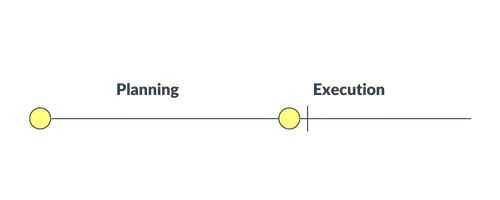
When “planning” is what you want out of it, the kickoff comes very early in the process. Sort of just after you got a sign-off on the project definition, a client payment, or/and have a steering group.

Pros of having the kickoff to facilitate planning:
- You will get a high buy-in from the people attending at this early stage.
- You will get a steering group that sees the reality of the project and not only reports.
- You will minimize missing any important risks or dependencies, which your team knows about.
- You will get a more realistic time plan listening to the people who will do the work, than you or their managers estimating the timings.
Con’s of having the kickoff to facilitate planning:
- Since activities and estimations have not been done, the resources are not secured. So you might end up having other people in your project than are attending the kickoff
- You will need to act fast after the meeting to complete and anchor the project plan, not only with the resource owners and steering group but also with the team.
- If anything comes up at the meeting that risks the whole existence of the project, it becomes a communicative challenge to close it down this early.
Starting point
Some companies have kickoff as a starting point in the project and it is not until after this point that the project is “live”. This means it is not until after this meeting that you will have access to the resources and need to start reporting. For this to work, you have done a lot of preparation and work before the kickoff. You have collaborated with the resource owners to get the needed activities down, an estimation of the need for resources has been done and they have also been secured.
The meeting will then be half information, half input. Information about the objective, the timings, and the plan as you see it right now. Then the team can provide input on the created plan. What you will notice is that the group will focus on the risks with what you present. That is because our brains are wired for protection and spot risks. So you will need a way to balance the energy to get that valuable input, but not tilting the whole meeting into a “problem”-meeting.
When the purpose is to have it as a starting point, the kickoff comes a bit later in the process.

Pros of having the kickoff to get a start:
- You will have better control over the content since you have been doing a lot of the preparation beforehand.
- You will know that the people in the room are secured to start working the day after and you can steer where they put their time.
- There are fewer people to anchor with since everything is set.
- Communication becomes high energy being “Project x has started!” and you can present the milestones and next steps easily.
Con’s of having the kickoff to get a start:
- Less buy-in and risk for people seeing problems when they have not been part of creating the plan.
- Despite pre-work, there is a higher risk of different stakeholders having different views on what is actually going to happen. Information skews over time.
- You will need to deliver a revision of your plan based on your teams’ input, re-anchoring with stakeholders again.
Energy & attention
If you take it even further, sometimes a kickoff is just an anchoring point and has the meaning of getting a rocket start in the project. In this case, you want no new input into an already agreed plan, but you want everybody to understand what will happen and learn to know each other if they do not already do that.
This will be a pure information meeting and interaction will be focused on fun and high-energy activities. You will probably have a larger group invited and celebrate this new great project. The invited must be aware of the purpose and agenda so they do not “ruin your party”. The people who are going to be involved in the project, need to know where and when they will or have been invited to the table to provide their input or worries.
When getting attention to your project in this way, it usually happens very very early to draw attention to your company. Or very very late when you have secured everything and need that energy boost before you start working.
Pros of having the kickoff as an energy boost:
- It is fun and joyful, the team will remember that.
- There is not much need for facilitation, you can be more social.
- The project gets attention and puts you on the map regarding internal politics for resources.
- You can steer the communication to a larger group of people at one point, ensuring they all get the same information.
Con’s of having the kickoff as an energy boost:
- There will be opinions. There always are. So the “work” needs to happen before or after this event.
- It is usually costly having more people and fun activities, somebody needs to pick up the bill.
- Starting strong puts higher pressure on the project to keep everybody informed and involved throughout the whole journey, so make sure your communication plan is in place.